The Hidden Evolution of Disguised Visual Context inside the VLM


Motivation
Visual tokens enter a language model as raw, foreign signals. How they are transformed into meaningful representations and interact with the language inside LLM depends entirely on the integration architecture. Several integratio paradigms exist, from simply concatenating visual tokens into the input sequence to injecting them at intermediate layers for efficient attention computation. Yet, There is little evidence for which paradigm is better, most of existing comparisons vary in training data, token budget, model scale and optimisation. Furthermore, how each paradigm reshapes visual representations across layers remains underexplored.
Integration Paradigms

We compare three paradigms, each widely adopted and representative of a distinct design philosophy for delivering visual context into an LLM.
-
In-context injection (IN-CT) projects visual features through a connector and concatenates them with text at the input, so both pass through the LLM’s standard transformer blocks together. This is the LLaVA design [1].
-
Layer-wise gated cross-attention injection (LW-GC) starts from text alone and feeds visual features through a layer-specific connector into a dedicated cross-attention block and gated FFN at each layer, both scaled by learnable gates initialised at zero. This follows Flamingo [2].
-
Layer-wise attention injection (LW-AT) also starts from text alone and injects at every layer, but into the keys and values of the LLM’s existing attention, bypassing the FFN sublayers. It sits between the other two, injecting layer by layer like LW-GC while letting visual and text tokens interact in standard attention like IN-CT. This follows the LAL design from PAL [3].
All three share the same vision encoder, MLP connector and visual token count, with no token compression in LW-GC. Data, recipe and optimisation are held fixed across seven configurations spanning two model families and four scales, so differences can be attributed to the integration design itself.
Benchmark Results
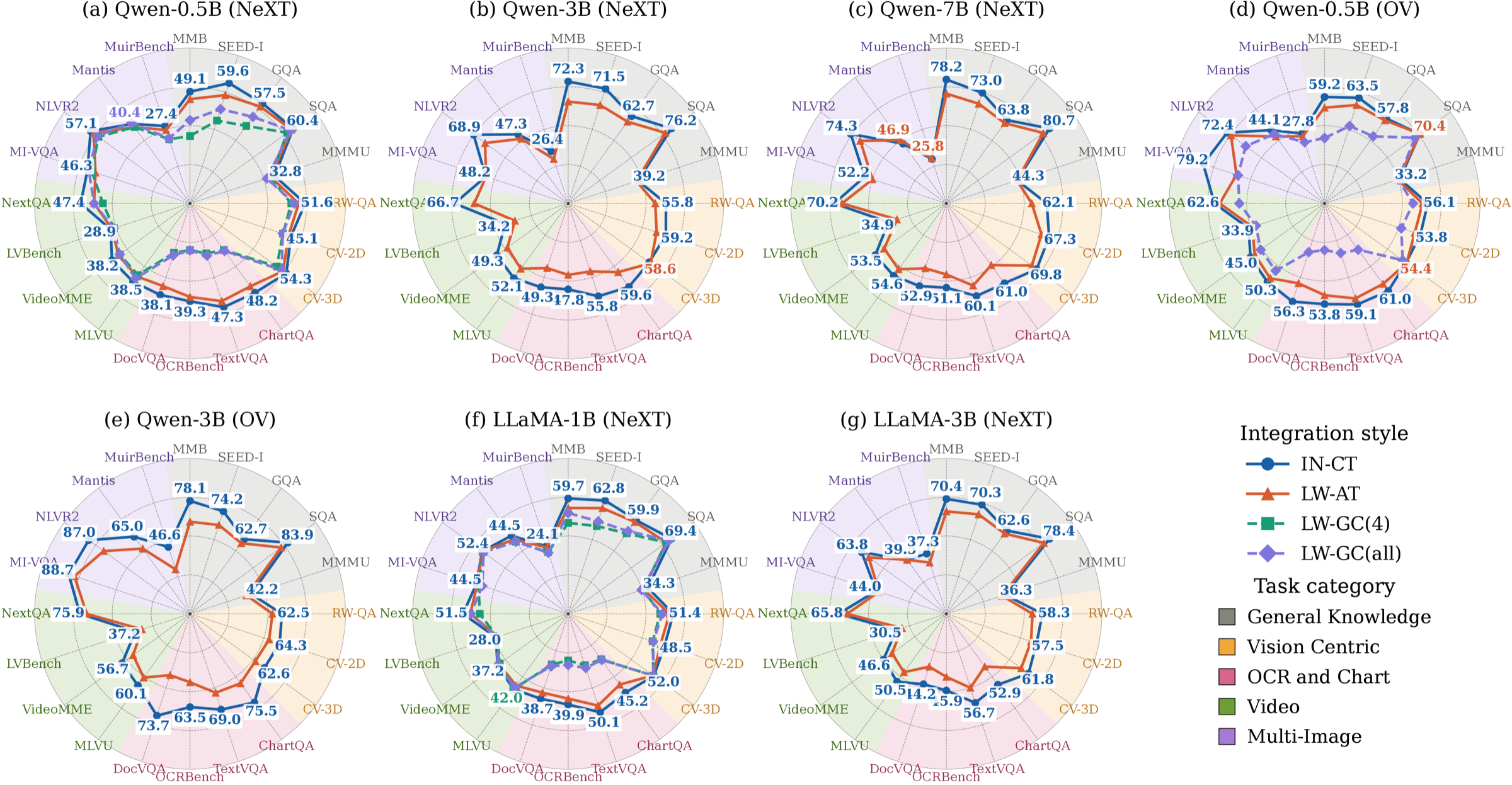
Across twenty benchmarks in five task families, IN-CT achieves the best overall results, followed by LW-AT, while LW-GC lags significantly. The ordering is consistent across single-image, multi-image and video settings. IN-CT and LW-AT stay close on general and knowledge benchmarks and separate most on OCR and video, where LW-GC falls away almost entirely.
Analysis
The benchmark results leave a consistent gap between in-context and layer-wise injection. What causes it? We examine four things inside the LLM. Whether visual tokens semantically evolve across layers, what visual features they capture, whether they align with the language representation space, and when the model uses them during generation.
Representation Evolution and Frequency
Centered kernel alignment between layers shows two regimes. Under IN-CT, visual tokens undergo a smooth, uniform transformation across layers, mirroring the progressive refinement of text tokens, with residual connections keeping each layer’s change incremental. Both layer-wise paradigms show severe discontinuities instead, because their visual tokens have no residual connections and each layer receives an independent projection of the original encoder features. Text tokens behave almost the same under all three, so this is specific to vision.
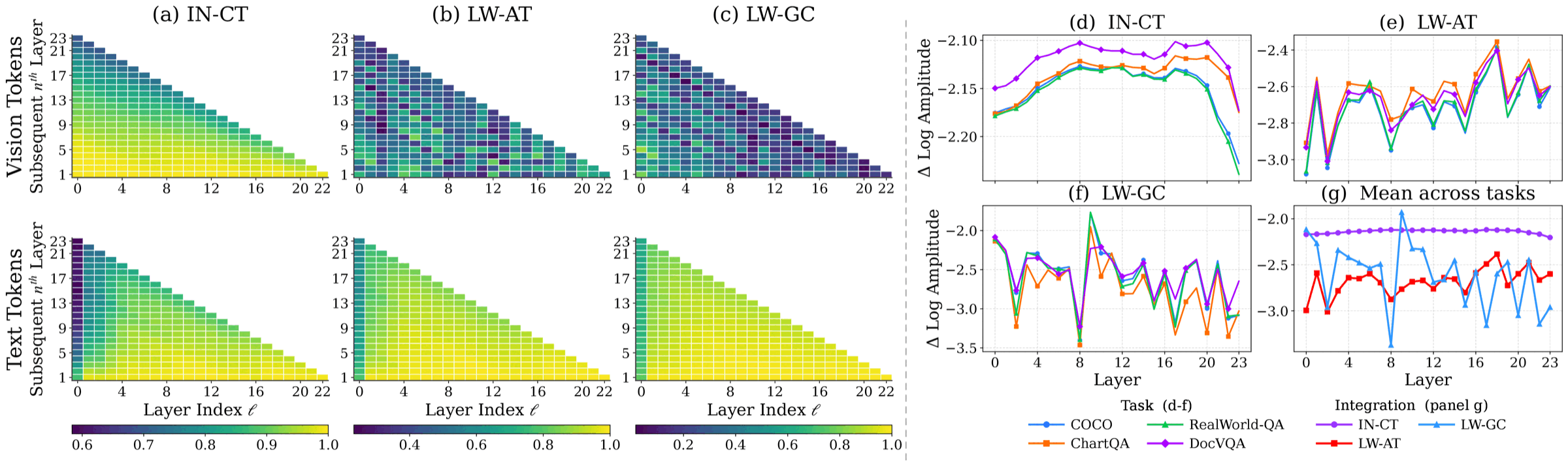
The frequency view shows which features survive. Under IN-CT the relative log amplitude rises gradually through the early and middle layers, a progressive shift toward fine-grained local detail such as texture and edges, which may explain its advantage on OCR and video. LW-AT fluctuates but stays relatively stable and lower-frequency on average, and LW-GC oscillates erratically with no coherent trend, also low-frequency biased. IN-CT then drops sharply in the final layers, consolidating that fine detail into more abstract, global representations.
Modality Alignment and Usage
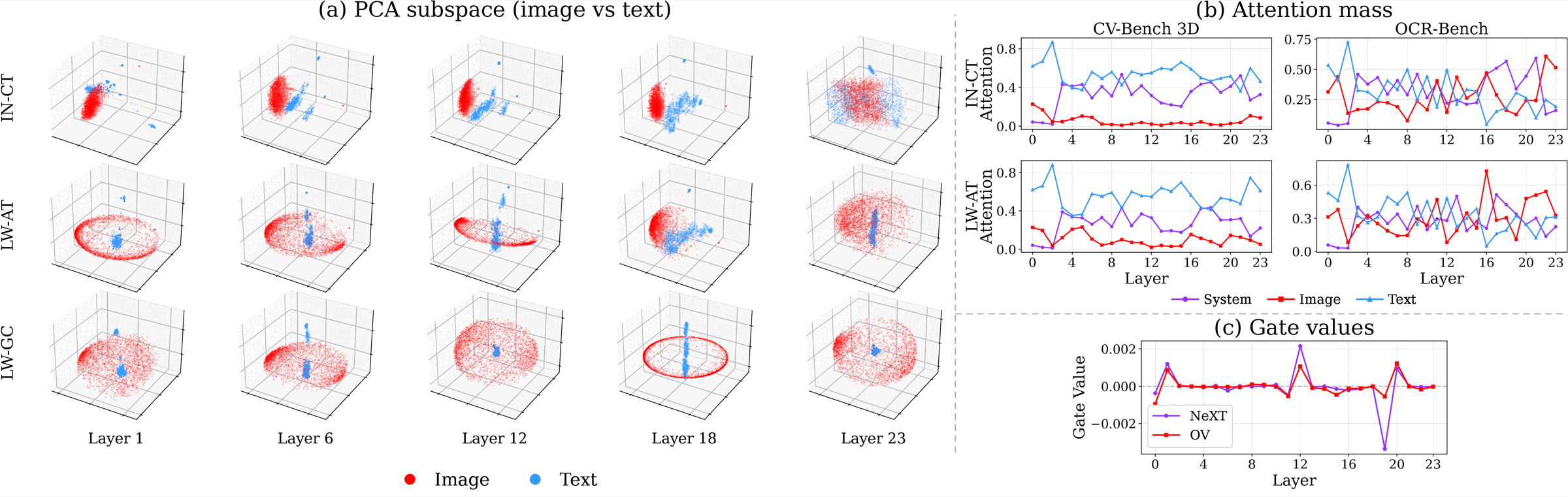
Projecting image and text tokens into a shared subspace shows two different behaviours. Under IN-CT, image tokens already carry semantic structure from the vision encoder in the early layers, while text tokens have yet to form meaningful representations. As text acquires semantics in the middle layers, both modalities occupy narrow cones separated by the modality gap. Deeper in the network these cones progressively merge, and by the final layers the two share a representational space. Under the layer-wise paradigms there is no such convergence, and image representations stay orthogonal to the language space throughout, which follows from their discontinuous evolution since nothing there reshapes them toward it.
Hybrid integration
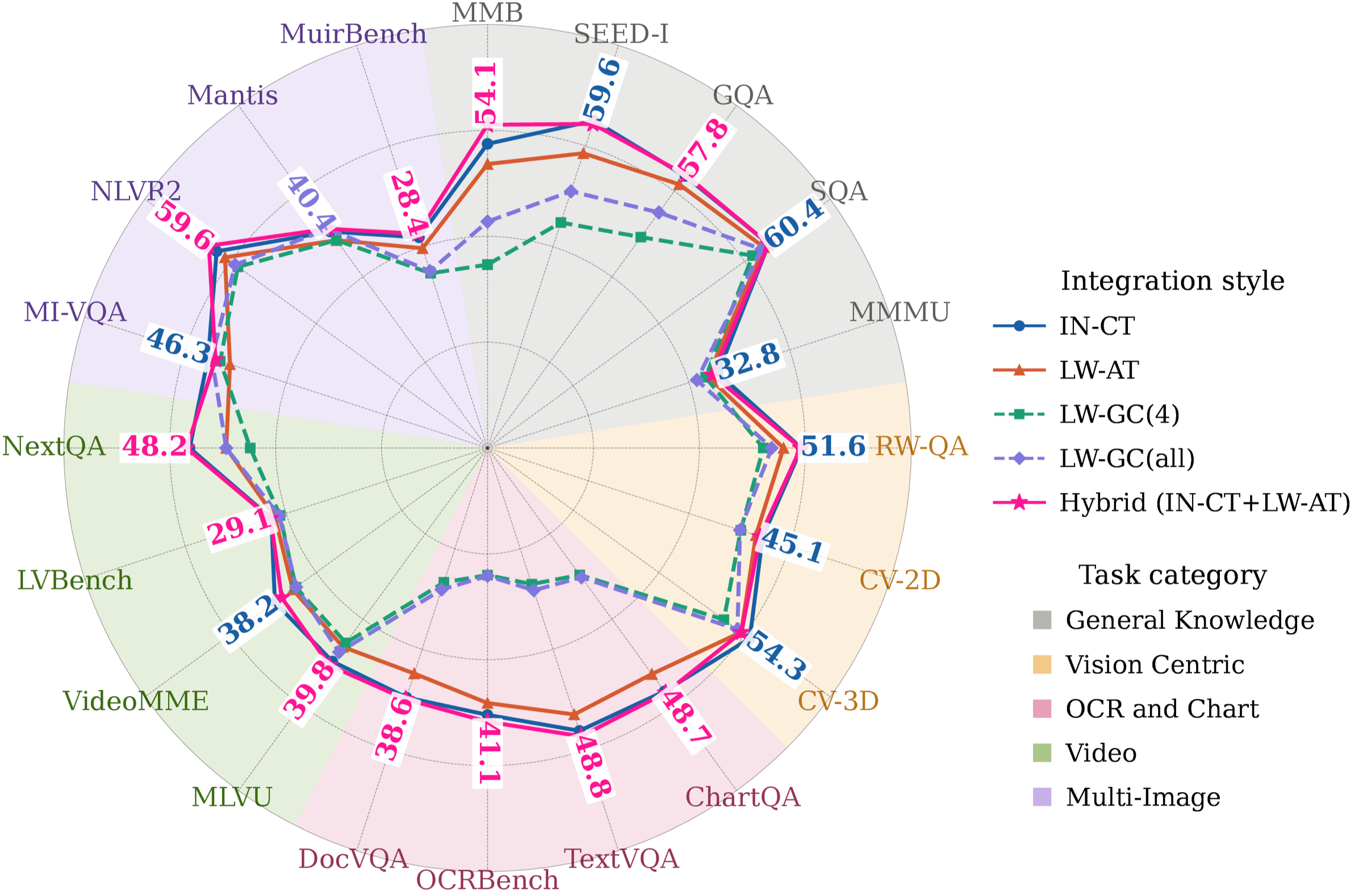
IN-CT and LW-AT capture complementary frequency characteristics, IN-CT progressively building high-frequency representations while LW-AT maintains low-frequency ones. To test whether both can be used at once, we combine them in a hybrid model, interleaving layer-wise attention injection before the in-context tokens with a one-to-one token mapping. The hybrid outperforms every other paradigm across most benchmarks, showing that a VLM benefits from access to both high-frequency and low-frequency visual features.
Takeaways
We compared in-context and layer-wise integration under identical training conditions. Under in-context injection, visual tokens evolve smoothly across layers, shifting toward high-frequency detail before converging with the language space, while under layer-wise injection they evolve discontinuously, stay low-frequency and remain orthogonal to it. The performance gap comes from the quality of these representations, not from how much attention the image receives, and combining both paradigms recovers the strengths of each.
While our study focuses on the vision-language setting, we believe these findings are relevant to the broader MLLM community. Different modalities may inherently benefit from different frequency characteristics, and understanding which integration paradigm best preserves the frequency properties critical to each modality could inform the design of more effective multimodal systems.
BibTeX
@article{suharitdamrong2026hidden,
  title   = {The Hidden Evolution of Disguised Visual Context inside the VLM},
  author  = {Suharitdamrong, Wish and Alex, Tony and Zhu, Xiatian and Awais, Muhammad and Atito, Sara},
  journal = {arXiv preprint arXiv:2606.20077},
  year    = {2026}
}
References
- Liu, H., Li, C., Wu, Q., Lee, Y. J. Visual Instruction Tuning. NeurIPS, 2023. arxiv.org/abs/2304.08485
- Alayrac, J.-B., Donahue, J., Luc, P., et al. Flamingo: a Visual Language Model for Few-Shot Learning. NeurIPS, 2022. arxiv.org/abs/2204.14198
- Alex, T., Suharitdamrong, W., Atito, S., et al. PAL: Probing Audio Encoders via LLMs. arXiv preprint, 2025. arxiv.org/abs/2506.10423